 Shabtabnews In this dark night, I have lost my way – Arise from a corner, oh you the star of guidance.
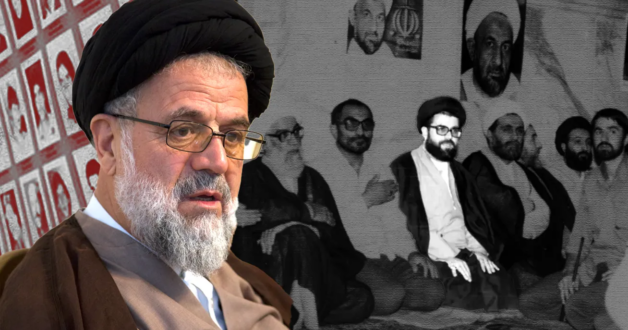
Iranwire – Hossein Mousavi Tabrizi stands as a symbol of “evasion of responsibility.” He represents how someone within the system could sign thousands of death warrants and later reappear as a reformist voice, writing in support of prisoners’ freedom.
On April 12, when news of the 79-year-old’s death in Qom made headlines, two sharply contrasting images of him resurfaced in Iran’s public space. One was of a white-haired cleric who, in his later years, spoke calmly about the “necessity of Islamic mercy,” led a reformist body, and defended the “rights of political parties,” as if his role was to soften Iran’s political climate. The other image comes from the violent reality of the 1980s, where a hardline Sharia judge and prosecutor signed death orders for political protesters and openly defended their execution.
Seyyed Hossein Mousavi Tabrizi reflects a broader pattern among officials of the Islamic Republic who helped build the system’s structural violence and later positioned themselves as critics or reformers—without acknowledging or taking responsibility for their past. Until the end of his life, he shifted between denying involvement in executions and offering religious justifications for them, illustrating how one could be part of a repressive system while later presenting themselves as a defender of human rights.
From the Chambers of Tabriz to the Bench of Judgment
Born in 1946 in the “Shotorban” (Davachi) neighborhood of Tabriz, he was originally named Seyyed Hossein Pourmirghaffari. He moved to Qom in 1962, but a key turning point came in 1966 when he relocated to Najaf. There, he was exposed to both the traditional jurisprudence of Abu al-Qasim al-Khoei and the political thinking of Ruhollah Khomeini, eventually aligning with Khomeini’s more radical approach as a path to rise.
After returning to Iran in 1968, he strengthened ties between the bazaar and the clergy by marrying into the family of Hossein Noori Hamedani, a senior cleric who would later support state repression. Following the 1979 Revolution, Mousavi Tabrizi quickly rose through the ranks. Known for his “extremism” in Qom, he was soon appointed as a Sharia judge and head of the Revolutionary Courts in East and West Azerbaijan provinces.
In 1980, he oversaw the trial related to the Cinema Rex fire in Abadan, one of the most shocking incidents before the revolution. Records from the proceedings suggest that the main perpetrators were never summoned, and the trial ended with the execution of Hossein Takbalizadeh and five others, some of whom were reportedly not even present at the time of the incident.
The Prosecutor General and the Logic of Eliminating Opposition
His actions brought him closer to Ruhollah Khomeini, and in September 1981, after the assassination of Asadollah Qoddousi, he was appointed as the second Prosecutor General of the Islamic Revolution. This phase marked the most violent period of his career.
Operating under a framework where eliminating opponents was seen as victory, he played a central role in the state’s crackdown. In one of his early interviews during the 1981 protests, he said:
“If these people are arrested, they will no longer be kept waiting for months to eat, sleep, and consume public funds. Their trial is in the street.”
He went further, stating that anyone opposing the system should be killed, adding that “the prisoner must be killed and the wounded must be finished off.”
In later years, when questioned about the 1988 mass executions, he tried to distance himself by claiming he was only a “Member of Parliament” at the time and unaware of the events. However, in a 2019 interview, he defended those executions, comparing opponents to the “Khawarij” and saying those who held their positions “certainly deserved execution.”
Balancing the Judge and the Reformer
By 2022, he had taken on a more critical tone. As Secretary-General of the Assembly of Qom Seminary Scholars and Researchers, he questioned how the state treated young people, stating: “The people are creditors and must raise their voices to defend their rights.”
After the death of Mahsa Amini, the same figure who had once justified killings and rejected repentance spoke differently, saying: “It is very bad that Iranian youth do not have security in Iran… Where in religion or Sharia does it allow officers to arrest someone in that manner?”
Mousavi Tabrizi remains a figure defined by “evasion of responsibility.” With his passing, many details about the Revolutionary Courts and decisions of the 1980s may remain hidden. Yet, his legacy reflects a system that never fully accounted for its past, merging a “bloody past” with “democratic gestures” to sustain itself through shifting narratives.