 Shabtabnews In this dark night, I have lost my way – Arise from a corner, oh you the star of guidance.
Iranwire – An eyewitness has spoken to IranWire about the killing of Alireza Rahimi, a 26-year-old protester from Tehran, by security forces of the Islamic Republic.
According to the witness, at the moment Alireza Rahimi was targeted by direct live fire from government forces, he was standing on the side of the street talking to his friends.
The individual, who requested anonymity for security reasons, told IranWire, “He was 26 years old, born in 1997. He had a twin brother named Amirreza. He was an incredibly emotional and kind person. He owned a shop selling Kia Motors spare parts in the Cheragh-Bargh neighborhood. He loved music and dancing, and for years had been devoted to a girl. Alireza was the most romantic person.”
The eyewitness said that Alireza, along with several friends and relatives, went to the Tehranpars neighborhood on Thursday, January 8, to take part in the protests.
“He told us his grandmother’s family lived ten minutes away. His phone rang and a relative asked where he was, saying they were worried. They told him to head toward Aryashahr because they thought it would be safer. Less than a minute after he ended the call, we heard gunfire. We saw people shooting from above.”
The witness said it appeared the shooters were firing at the crowd from the rooftop of the mosque and the Basij base at Al-Aqsa Mosque.
“Everything happened in the blink of an eye. I saw Alireza fall face-first, and the asphalt was covered in blood. He had been shot directly in the back of the head. We picked him up and, while bullets were still being fired, moved toward Third Square and Tehranpars Hospital.”
According to the witness, Alireza Rahimi was among the first injured, which allowed the hospital to admit him.
“The doctors and nurses truly tried. Despite the head wound, they did everything they could. But it was already over.”
Beginning the next day, Alireza Rahimi’s family not only had to endure his death but also scenes the witness described as “hell on earth.”
He recounted what he saw and heard from those present, “At Tehranpars Hospital, they took Alireza’s details and told the family to go to Behesht-e Zahra the next day to collect his body. On January 9, Behesht-e Zahra looked like the Day of Judgment. At first, they were told there was no such body. After two hours, they were directed to search the warehouses known as the ‘Meraj Warehouses.’”
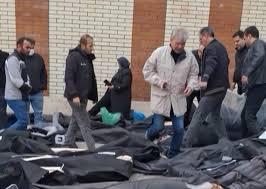
According to the witness, the Meraj warehouses were overflowing with bodies.
“Two thousand corpses were piled in each warehouse. Families had to unzip body bags one by one, move aside blood-soaked cotton, and search for their loved ones. The sound of wailing and mourning echoed throughout the space.”
A source told IranWire, “One of the warehouses was a catastrophe. There were three thousand body bags, all containing young women and girls. They say anyone who entered that warehouse came out having lost their mind.”
Eventually, Alireza Rahimi’s family and friends sought help from an ambulance driver.
“He said he would help but asked for a ‘sweetener’ in return,” the source said. “They collected money and gave it to him. He then told them to go to the back, where several ambulances and refrigerated dairy transport trucks were parked. ‘Open them,’ he said. ‘They are full of bodies. The warehouses had no more space, so they kept them there.’”
Alireza’s body was found in one of the ambulances.
However, the Medical Examiner’s Office refused to list a gunshot wound as the cause of death. Instead, the death certificate stated “blunt force trauma” as the cause.
According to the source, during Alireza Rahimi’s funeral and mourning ceremony, the family did not recite the Quran.
Instead, they played the flute and performed traditional ululations (kel). His car was decorated with flowers like a “wedding car” and brought to the ceremony.